Rashtrapati Bhavan sets an Example, ERP SAMARTH, Low-Cost PPE
May 15, 2020 · Param IAS Team
1. Rashtrapati Bhavan sets an Example
As a part of steps to make more resources available for Covid-19 relief measures, the President of India, Shri Ram Nath Kovind, after contributing one month’s salary to the PM-CARES Fund in March, has decided to forego 30 percent of his salary for a year.
The Rashtrapati Bhavan will undertake the following measures to reduce its expenditure:
- No new capital works will be taken up in FY 2020-21. Only the ongoing works will be completed.
- Repair and maintenance work will be minimised to only ensure proper upkeep of assets.
- There will be substantial reduction in the use of office consumables. For instance, the Rashtrapati Bhavan will use e-technology to cut down the use of paper to avoid wastage and make the office eco-friendly. Efforts will be made to save energy and fuel by rationalising their usage.
- The President has decided to defer purchase of the Presidential Limousine which was to be used for ceremonial occasions. The existing resources of the Rashtrapati Bhavan and the Government will be shared and used for such occasions.
- The domestic tours and programmes will be substantially reduced in order to follow the social distancing restrictions and minimise the expenditure that such exercises entail. Instead, the President will largely rely on technology to reach out to people.
- Consumption during ceremonial occasions such as At-Home ceremonies and state banquets will be minimised by taking measures like:
- Keeping smaller guest lists to maintain social distance,
- Lesser usage of flowers and other items for decoration on such occasions, and
- Reducing the food menu to the extent possible.
It is estimated that these measures will save nearly 20 percent of the budget of the Rashtrapati Bhavan in the current financial year.
Meanwhile, it will be ensured that such austerity measures would have no adverse impact on support given to outsourced/contractual workers. Other activities taken up by the Rashtrapati Bhavan for the welfare of poor people will not be affected either.
2. Innovative Low Cost PPE developed by Indian Navy Paves way for Rapid Mass Production
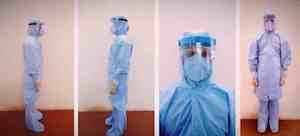
- In a major step towards rapid mass production of the Medical Personal Protective Equipment (PPE) developed by the Indian Navy, a patent has been successfully filed by the Intellectual Property Facilitation Cell (IPFC) of Min of Defence, in association with National Research Development Corporation (NRDC), an enterprise under Min of Science & Technology.
- The low cost PPE has been developed by a Doctor of Indian Navy, posted at the recently created Innovation Cell at Institute of Naval Medicine (INM), Mumbai. A pilot batch of PPEs has already been produced at Naval Dockyard Mumbai.
- The PPE developed by the Navy is made of a special fabric which affords high level of protection along with high ‘breathability’ as against other PPEs available in the market and is therefore more suitable for use in hot and humid weather conditions as prevalent in India. The technology has also been tested and validated by ICMR approved Testing Lab.
- The team of Innovators from Navy is working in close coordination with IPFC which was set up under Mission Raksha Gyan Shakti. Since its launch in Nov 2018, around 1500 IP assets have been created under Mission Raksha Gyan Shakti.
3. Finance Minister announces short term and long-term measures for supporting the poor, including migrants, farmers, tiny businesses and street vendors
- Free food grains supply to Migrants for 2 months.
- Technology system to be used enabling Migrants to access PDS(Ration) from any Fair Price Shops in India by March,2021-One Nation one Ration Card
- Scheme for Affordable Rental Housing Complexes for Migrant Workers and Urban Poor to be launched
- 2% Interest Subvention for 12 months for Shishu MUDRA loanees- Relief of Rs. 1500 crore
- Rs 5000 crore Credit facility for Street Vendors.
- Rs70,000 crore boost to housing sector and middle income group through extension of Credit Linked Subsidy Scheme for MIG under PMAY(Urban)
- Rs 6,000 crore for Creating employment using CAMPA funds
- Rs 30,000 crore Additional Emergency Working Capital for farmers through NABARD
- Rs 2 lakh crore concessional credit boost to 2.5 crore farmers under Kisan Credit Card Scheme
4. NIT Kurukshetra Implements Enterprises Resource Planning (ERP), SAMARTH
- SAMARTH is an e-Governance platform, developed under National Mission of Education in Information and Communication Technology Scheme (NMEICT) of M/o HRD
- SAMARTH to enhance productivity through better information management in the institute by seamless access to information.
- ERP, SAMARTH, is an Open Standard Open Source Architecture, Secure, Scalable and Evolutionary Process Automation Engine for Universities and Higher Educational Institutions.
- It caters to faculty, students and staff at a University/Higher Educational Institutions. Now, the ERP, SAMARTH, has been implemented at National Institute of Technology, Kurukshetra, a participating unit under the World Bank supported Technical Education Quality Improvement Program (TEQIP).
- The objective of this initiative is to automate the processes of the Institute.
- This initiative will enhance the productivity through better information management in the institute by seamless access to information, and its utilization for various purposes.